Drill&Chill: Idle Miner Tycoon
- 4.7
- Rating
- 1.00M
- Installs
- Free
- Price

 Analysis by App-foxy
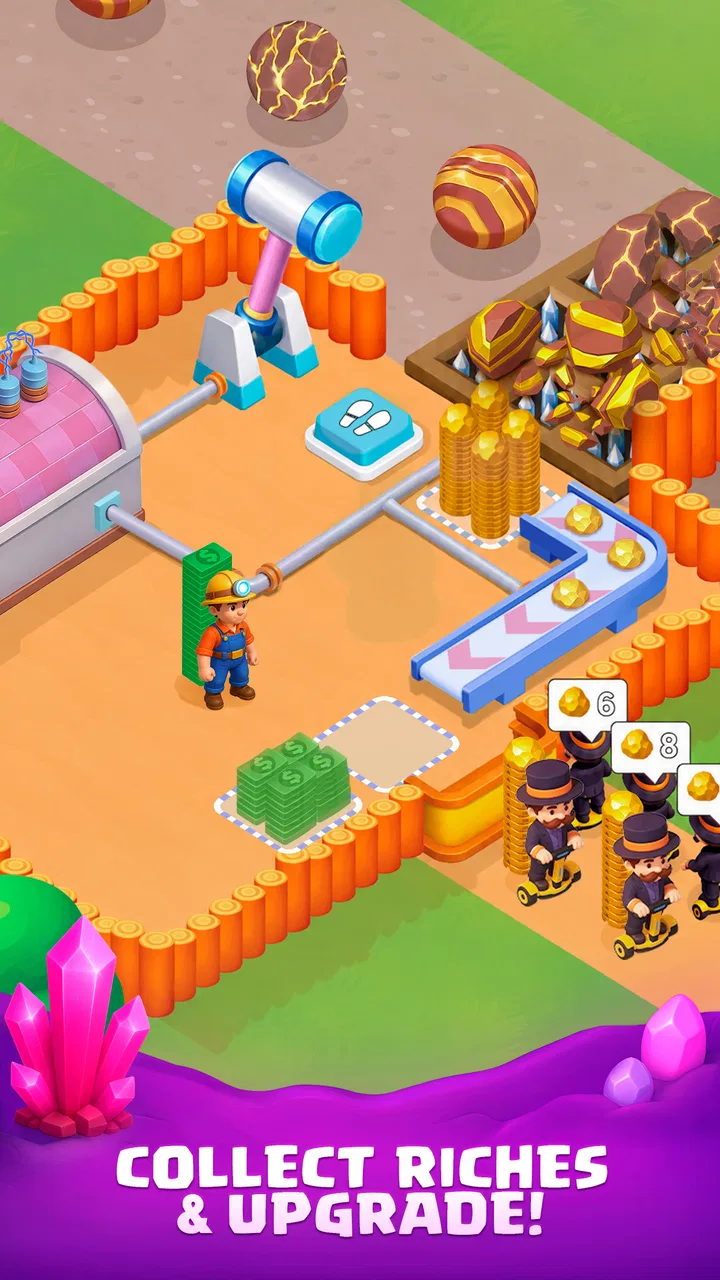
I went into Drill&Chill: Idle Miner Tycoon expecting a quiet mining simulator, and that is exactly where its appeal begins. You start with a simple action: drilling into the ground, watching resources come in, and deciding what deserves the next upgrade. The game does not ask me to master complicated controls before I can enjoy it. Instead, it builds its entertainment around a clear cycle of action, visible feedback, a small reward, and the temptation to begin another short session.
That makes this a particularly approachable simulation game for people who like progress they can see immediately. I can open it for a few minutes, improve something, collect the result, and leave with the feeling that the next visit will be worthwhile. It is free to play, rated for Everyone, and developed by Smart Project GMBH, so it presents itself as an easygoing option rather than a demanding strategy title.
Starting with the drill instead of a complicated tutorial
The first useful thing about the design is how quickly the central idea becomes understandable. Mining is not presented as a distant management spreadsheet; it is the activity that gives the whole game its identity. I drill, watch the operation produce value, and use that value to make the operation more capable. Even without a long explanation, the relationship between work and improvement is easy to follow.
You May Also Like

 Blood Strike: 2.5 Anniversary
Blood Strike’s Loadouts Turn Every Drop Into a Tactical Gamble
A close look at Blood Strike’s custom loadouts: how fast access to signature weapons reshapes its battle royale rhythm, rewards preparation, and narrows the gap between fights.

 Pandora - Music & Podcasts
Pandora’s Music Is Easy to Start, but Harder to Recover
Pandora’s strength is its low-effort path from a seed to a station. Its weak spot is how much confidence it asks you to place in connection, setup, and quiet recovery.

 8 Ball Pool
 Is Built on Rivalries, Rematches, and Routine
A close look at the rivalries, rematches, shared routines, and unanswered safety questions that turn a quick pool match into a persistent mobile community.

 Samsung Music
’s Quiet Strength Is Playing What You Already Own
Its reach comes less from spectacle than from dependable access to a personal library. That simplicity is both the app’s strongest retention engine and its ceiling.

 AccuWeather: Weather Radar
AccuWeather Review: A Quick, Clear Forecast for Everyday Decisions
For everyday plans, the best forecast is the one you can understand quickly. AccuWeather makes rain timing, radar, and local conditions easy to act on, with a few trade-offs.

 Hill Climb Racing
Why Hill Climb Racing Still Turns Crashes Into One More Run
A tiny car, a bumpy hill and one more upgrade: Hill Climb Racing keeps resurfacing because its simple chaos makes every near-miss feel personal.
More From Our News Desk



That first action matters because idle games can sometimes bury their best idea beneath menus, currencies, and instructions. Here, the mining theme gives the opening a physical feeling. The drill is the reason resources appear, upgrades have a purpose, and collecting wealth feels connected to what I have just done. I am not simply pressing a reward button with a decorative mine in the background.
For a new player, my advice is to resist the urge to spend every early reward immediately. First watch what changes after an upgrade. Does the operation feel faster, more productive, or simply more valuable? Paying attention to that relationship helps you understand which improvements support the way you play. Someone who checks in frequently may value immediate activity, while someone who prefers longer gaps between sessions will care more about progress that keeps moving while away.
The accessible opening also makes the game suitable for a quick break. I can imagine playing it while waiting for transport or between household tasks, because the basic decision does not require a long uninterrupted session. That simplicity is a strength, although players searching for a complex mining economy should know that the attraction comes from the rhythm of improvement rather than from highly technical simulation.
Why the mining action feels satisfying
The most enjoyable part of the opening is the connection between an input and a visible outcome. I perform the mining action, see the operation respond, and then have a reason to consider the next improvement. That sequence is more satisfying than a system where the player only collects abstract points with no clear source.
There is also a useful psychological distinction between drilling and collecting. Drilling represents the ongoing activity, while collecting turns that activity into a decision. I am not only watching numbers rise; I am choosing when the current result is worth claiming and reinvesting. That small pause creates the first meaningful piece of judgement in the game.
The best way to approach the opening is to treat every reward as an experiment. Upgrade one part, observe the new pace, and then decide whether the next purchase improves the experience you actually want. This prevents the early game from becoming a blur of automatic taps and gives each improvement a practical purpose.
How the feedback rhythm keeps another session tempting
Once the first upgrade has been made, the game’s rhythm becomes clearer. The action produces feedback, feedback leads to a reward, and the reward points toward another upgrade. That rhythm is the heart of the experience. It is not about one dramatic victory; it is about a chain of small confirmations that tells me the mine is becoming more productive.
I found this rhythm more important than the individual controls. The controls are straightforward, but the timing of the feedback determines whether the game feels alive. When progress is easy to notice, even a short visit has a beginning and an end. I arrive with a goal, make an improvement, and leave knowing what I might do next time.
This is where the idle structure changes the usual idea of a session. In a conventional action game, progress mostly depends on what I do while actively playing. In this mining simulator, the appeal is also in returning to see what the operation has produced. That makes the game less suitable for players who need constant interaction, but more convenient for anyone who enjoys checking a project that continues to develop between visits.
The trade-off is that the feedback can become predictable. The same loop that feels calming at first may feel repetitive if I want new challenges every few minutes. I would not choose this as my main game when I am looking for fast reactions, deep exploration, or a story-led campaign. I would choose it when I want a low-pressure activity where the reward comes from gradually improving a system.
Making short sessions work better
I get more from the game when I give each visit a narrow purpose. One session can be about collecting and making a single meaningful upgrade. Another can be about checking whether the current setup is strong enough to leave alone for a while. This approach keeps the loop from becoming mindless and makes the return visit feel intentional.
It is also worth separating active attention from passive progress in your own expectations. If I open the game expecting a constant stream of decisions, the idle design may feel too quiet. If I open it expecting a quick check-in followed by gradual growth, the same design becomes its strongest feature. The game rewards patience more than frantic tapping.
A realistic everyday use case would be a short evening break after work. I can open the mine, collect what has accumulated, improve the operation, and stop before the session expands into a long commitment. The next day, I have a clear reason to return: there is another result waiting to be checked. That is a modest loop, but it fits neatly into a busy routine.
Rewards that turn mining into a management decision
The reward system works because it is tied to the mine’s visible development. Wealth is not merely a score to admire; it is fuel for making the operation stronger. That gives every collection a question behind it: should I spend now, or allow the current setup to continue until a more useful improvement is available?
I prefer this kind of reward structure to a system that gives constant prizes with no meaningful choice. Even when the decisions are simple, the player still has a reason to look at the current state before pressing the next button. The satisfaction comes from turning a small amount of accumulated value into a change I can feel during the next cycle.
One subtle strength is that the reward is both an ending and a beginning. Collecting closes the current stretch of mining, but it immediately creates the next objective. That prevents the session from ending with a completely empty feeling. I finish one task and leave with a new target, whether that means another upgrade or simply waiting for the next useful return.
My main caution is to avoid judging every reward by its size alone. A larger collection is not automatically better if it does not lead to a useful improvement. I found it more helpful to think in terms of momentum: which choice will make the next few visits more satisfying? That mindset is especially useful in idle games, where a small improvement can matter more than a flashy but poorly timed purchase.
Who will appreciate this reward loop
This design should suit players who enjoy incremental progress, light resource management, and a relaxed pace. It is also a good fit for someone who likes the idea of a tycoon game but does not want to begin with a dense business simulator. The mining theme gives the numbers a concrete context, while the simple loop keeps the mental load low.
I would be more cautious recommending it to players who need a strong sense of mastery. If your enjoyment comes from discovering complicated systems, optimizing many variables at once, or competing against difficult opponents, the straightforward reward cycle may not provide enough depth. A conventional strategy game would likely be a better choice in that case.
The age rating of Everyone makes the presentation broadly approachable, but that does not mean every player will find the pace equally engaging. Younger players may enjoy the immediate connection between drilling and collecting, while adults may value it as a gentle time-filler. The important question is whether gradual progress sounds relaxing or repetitive to you.
Resetting the session without losing the reason to return
Every visit eventually reaches a natural reset point. I collect the current result, make the next decision, and close the game. This reset is not a dramatic restart; it is a handoff from one small objective to another. The mine remains the larger project, while each session becomes a manageable piece of it.
That structure is one reason the game feels easy to fit around real life. I do not need to reserve a full evening to feel that I have accomplished something. A short check-in can still produce a collection or an upgrade. When I return later, the previous session has not been wasted; it has prepared the next one.
At the same time, the reset can expose the game’s main limitation. Because the session closes through the same basic pattern, the long-term experience depends heavily on whether you enjoy repetition. The design does not hide that repetition, and it should not be approached as if it were an action adventure with constant surprises. Its pleasure comes from refinement, not reinvention.
I recommend deciding in advance how often you want to check the mine. If you open it compulsively after every tiny change, the loop can lose its sense of occasion. If you give the operation enough time to produce a meaningful result, collection feels more rewarding and the next upgrade has clearer context. This is a small habit, but it makes the idle format feel less like busywork.
What to expect over longer use
Over time, the question shifts from “What can I collect right now?” to “What kind of mining rhythm do I want to build?” That is a more interesting question because it asks me to consider my own play style. Frequent players can engage with the mine often, while casual players can treat it as a background project that deserves occasional attention.
The current version is 1.8.6708, and the game is available for devices running Android 7.0 or later. Those details make it practical for people using older compatible Android hardware, although the experience will still depend on how comfortable that device is with the game’s presentation and normal background activity. I would check compatibility before planning to make it a regular daily game.
Because it is free, the barrier to trying the loop is low. That is useful here: the game’s appeal is highly personal, and a few sessions quickly reveal whether the mining rhythm relaxes you or starts to feel repetitive. I would not recommend committing to it based only on the tycoon label. Try the opening, notice how the feedback feels, and decide whether the next reset genuinely makes you curious.
My verdict on the drill, reward, and return cycle
What makes Drill&Chill work is not a complicated feature list. It is the clarity of its central cycle. I drill, receive feedback, collect value, improve the mine, and leave with a reason to come back. Each part supports the next, so the game rarely feels confused about what it wants me to do.
The strongest part is the tangible link between action and progress. Mining gives the reward a believable source, and upgrading gives the reward a practical destination. The weakest part is the same loop’s predictability. If you need constant novelty or demanding strategy, this will probably feel too gentle. If you enjoy watching a small operation become more capable over repeated check-ins, the simplicity becomes an advantage.
The game has built a substantial audience, with a 4.7 average from around 3.9 thousand ratings and more than a million installs. Those figures do not replace personal taste, but they do fit my impression that the accessible idle-mining formula has broad appeal. I can see why someone would keep it installed as a dependable five-minute game.
My recommendation is straightforward: choose it if you want a free, low-pressure simulation that turns brief visits into visible progress. Skip it if you are looking for complex economic planning, intense manual control, or a constantly changing adventure. For me, the most convincing reason to return is the clean handoff between sessions. I never need to wonder what the next visit is about: check the mine, claim the result, make one smart improvement, and see how far the next cycle can go.
FAQs for Drill&Chill: Idle Miner Tycoon
01What is Drill&Chill: Idle Miner Tycoon?
Drill&Chill: Idle Miner Tycoon is a casual simulation game where players manage a mining operation. You extract resources, upgrade equipment, and expand your empire while idly generating income. The game is designed for both active engagement and passive play, allowing for a relaxed gaming experience.
02Is Drill&Chill: Idle Miner Tycoon free to play?
Yes, Drill&Chill: Idle Miner Tycoon is free to download and play. However, it offers in-app purchases for various items and upgrades. These purchases can enhance gameplay but are not necessary to enjoy the core experience. Players can progress without spending money, although it might take longer.
03What are the main features of Drill&Chill: Idle Miner Tycoon?
Drill&Chill: Idle Miner Tycoon features include multiple mines to explore, a variety of resources to collect, and a range of upgrades to enhance mining efficiency. The game also offers events, achievements, and leaderboards to keep players engaged. Its idle mechanics allow for progress even when not actively playing.
04Does Drill&Chill: Idle Miner Tycoon require an internet connection?
Drill&Chill: Idle Miner Tycoon can be played offline, which is great for players without constant internet access. However, some features, like events and leaderboards, require an internet connection. Offline play allows for resource collection and upgrades, providing flexibility for users on the go.
05How does progression work in Drill&Chill: Idle Miner Tycoon?
Progression in Drill&Chill: Idle Miner Tycoon involves upgrading your mining equipment and expanding your operations to unlock new mines and resources. Players earn income from their mining activities, which can be reinvested to accelerate growth. Strategic upgrades and balancing investments are key to maximizing efficiency.
Pros
- Engaging graphics with vibrant animations.
- Simple controls for easy gameplay navigation.
- Frequent updates with new content and features.
- Offline mode available for uninterrupted play.
- No intrusive ads
- enhancing user experience.
Cons
- Progression can feel slow without in-app purchases.
- Repetitive tasks may become monotonous over time.
- Limited social interaction with other players.
- Requires regular updates
- which can be large.
- Some features locked behind paywalls.

Drill&Chill: Idle Miner Tycoon
Gallery